


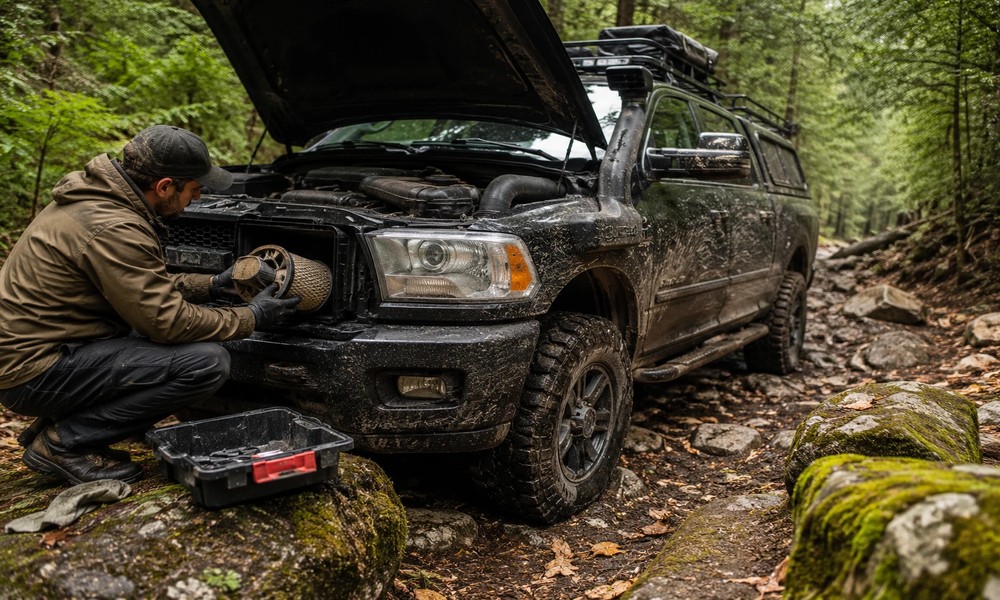
A diesel truck driven daily on paved roads and a diesel truck used regularly for off-road wheeling, overland travel, or work on unpaved job sites are operating in fundamentally different environments – and they need fundamentally different maintenance approaches to match. The factory service intervals in every diesel truck owner’s manual are calibrated for normal operating conditions: paved roads, predictable ambient temperatures, fuel from established stations, and loads within the rated capacity. Off-road use violates every one of those assumptions simultaneously.
Dust, heat, water crossings, sustained low-gear operation, rough terrain vibration, and remote-location fuel sourcing all accelerate the degradation of components that standard intervals were not designed to protect against. Understanding precisely which systems are most affected by off-road use – and exactly how to adjust the maintenance schedule around them – is the difference between a diesel that holds up reliably through years of trail use and one that accumulates quiet damage that only becomes visible at high repair cost.
Air Filtration: The Most Critical Off-Road Maintenance Priority
Of every maintenance variable that changes under off-road use, air filtration is the most immediately consequential and the most commonly underestimated. A diesel engine at highway cruise draws between 9,000 and 12,000 cubic feet of air per hour through the intake system. On a paved highway, that air is relatively clean. On a dusty two-track, a fire road, or a dry trail behind another vehicle, that same airflow is carrying fine silica particles, clay dust, and debris that, if they reach the engine, become a lapping compound working against cylinder walls, piston rings, and valve guides with every combustion cycle.
The factory air filter service interval – typically based on a mileage threshold or a restriction gauge reading – assumes road driving conditions. Off-road use in dusty environments can load an air filter to its restriction limit in a fraction of that mileage. A filter that would last 15,000 miles on clean highway air may reach its service limit in 2,000 to 3,000 miles of dusty trail driving. Running a loaded filter past its restriction threshold is worse than running no filter at all in some respects: a partially collapsed or overloaded filter element creates bypass pathways that send unfiltered air – and everything it carries – directly into the intake stream.
The practical off-road air filtration protocol involves three adjustments from the standard approach. First, check the air filter at every oil change regardless of mileage, using the intake restriction indicator gauge or a visual inspection of the filter element in dusty conditions. Second, inspect all intake duct connections from the filter housing to the turbocharger inlet after every off-road trip – vibration, rock strikes, and flexing on rough terrain loosen clamps and crack ducts, creating unfiltered air bypasses. Third, consider a pre-cleaner fitted to the air intake snorkel for vehicles used in extreme dust: these centrifugal devices remove large particles before they reach the filter element, extending filter service life dramatically in the worst environments.
Fuel System: Contamination Risks Specific to Off-Road and Remote Operation
Modern diesel fuel injection systems operating at 20,000 to 36,000 PSI have near-zero tolerance for contamination. The fuel filter is the last line of defense between whatever is in the tank and injectors machined to tolerances measured in single-digit microns. On-road, the primary contamination risk is water from condensation or poor-quality fuel from infrequently serviced stations. Off-road, the contamination risk profile expands significantly. Proper diesel air filter maintenance and fuel filter replacement intervals become even more critical in off-road environments, where fuel sourced from remote locations, jerry cans, and auxiliary tanks introduces contamination pathways that highway fueling does not.
Jerry can and auxiliary tank fuel deserves particular attention. Fuel stored in portable containers picks up particulates from residue, moisture from temperature cycling, and microbial contamination if cans are not purged and dried between fills. Fuel sitting in an auxiliary tank installed in the truck bed is exposed to vibration that keeps sediment suspended and temperature swings that accelerate condensation. Running this fuel through the engine without additional filtration caution is accepting additional injector risk that a highway driver would never encounter.
For serious off-road use, two additional practices protect the fuel system beyond standard interval adherence. First, drain and inspect the water separator after every water crossing where the risk of water entering the fuel system through tank vents is real. Second, install an additional inline pre-filter between any auxiliary or jerry can fuel supply and the tank to capture the large-particle contamination that remote fuel sources routinely carry. These are not excessive precautions – they are the standard practices of expedition overlanders and vocational fleet operators who cannot afford injector failures in remote locations.
Drivetrain Fluids: Transfer Case and Differential Service Intervals Under Off-Road Load
The transfer case and front and rear differentials on a 4WD diesel truck are designed for occasional four-wheel-drive use and the kind of sustained torque that comes from normal towing and hauling. Sustained off-road use subjects these components to conditions that factory fluid change intervals do not account for: extended operation in low-range four-wheel drive, frequent engagement and disengagement of locking differentials, elevated heat from rock crawling and slow-speed climbs, and the possibility of water contamination if the differential breather tubes are not routed above wading depth.
Transfer case fluid serves as both the lubricant and the cooling medium for the gears and chain that distribute torque between front and rear axles. Under sustained low-range operation on technical terrain, the transfer case generates significantly more heat than highway driving produces. Heat degrades gear oil faster than any other factor – oil operating consistently near or above its thermal limit loses viscosity, oxidizes, and loses its extreme-pressure additive package at an accelerated rate. A transfer case fluid change interval of 30,000 miles under normal use may need to be shortened to 15,000 miles or less for a truck that regularly spends hours in low-range four-wheel drive.
Differential breather tube routing is an off-road-specific concern that stock trucks address inadequately for serious water crossing use. Factory breather tubes on front and rear differentials are typically routed just above the differential housing – which means any water crossing that submerges the axle can draw water into the differential as the hot oil contracts on entry. Extended breather tube routing to a high point on the firewall or inner fender is a straightforward modification that prevents this failure mode entirely. Before any water crossing that will submerge axle housings, confirm the current breather routing and evaluate whether extension is warranted for your typical terrain.
Cooling System Demands on Extended Grades and Low-Speed Terrain
Highway driving at cruise RPM allows a diesel’s cooling system to operate well within its design margins. Off-road driving on sustained climbs, slow-speed rock crawling with high throttle input, and extended idle while winching or recovering introduces heat loads that bring the cooling system much closer to its limits. The combination of high engine load, low vehicle speed (and therefore low airflow through the radiator), and elevated ambient temperatures from direct sun exposure on exposed terrain can push coolant temperatures into ranges that the truck rarely sees on the highway.
Coolant that is past its service life compounds this problem. Diesel coolant contains supplemental coolant additives (SCAs) that protect cylinder liners from cavitation erosion – the microscopic pitting that occurs when combustion pressure waves cause tiny vapor bubbles to collapse against liner surfaces. These additives deplete over time and distance, and a truck with degraded coolant operating under the elevated thermal stress of off-road use is accumulating cavitation damage that is invisible until it becomes a liner failure. Pre-trip coolant testing with test strips or a refractometer before any extended off-road trip, and coolant replacement on a shortened interval for trucks that see regular off-road use, is straightforward protection for an expensive component.
Radiator and intercooler conditions become more critical under off-road conditions. Trail debris, insects, and mud accumulate on the exterior of radiator and intercooler cores faster off-road than on pavement, reducing airflow efficiency. A compressed-air cleaning of the radiator face and intercooler core as part of post-trip maintenance removes this accumulation before it creates sustained cooling efficiency loss. Check coolant hose condition at every off-road service as well – vibration on rough terrain accelerates fatigue cracking in hoses near their clamps and connections.
Engine Oil and Service Intervals Under Off-Road Duty Cycle
Off-road operation changes the diesel engine’s duty cycle in ways that accelerate oil degradation faster than highway use at similar mileage. Extended low-gear, high-load climbing generates more heat and more combustion byproducts per mile than highway cruise. Frequent engine braking on descents creates oil dilution risk if the engine is not fully warmed to operating temperature before the load is removed. Sustained idling while operating a winch, running a power take-off, or waiting on trail produces soot loading without the engine temperature or oil circulation needed to burn off fuel dilution. The practical standard for an off-road diesel is to treat every significant off-road trip as severe-duty operation and adjust oil change intervals accordingly. Heavy-duty truck preventive maintenance schedules structured around A, B, and C service levels explicitly account for severe-duty operation by shortening intervals on engines that consistently operate under high-load, low-speed, or high-temperature conditions – exactly the profile that serious off-road use creates.
Oil analysis is particularly valuable for off-road diesel owners because the irregular duty cycle makes fixed mileage intervals a poor guide. A sample taken at the end of an aggressive off-road trip and compared against a baseline from a highway-only period of equivalent mileage often reveals significant differences in wear metal accumulation, soot content, and viscosity retention. That data – not a mileage threshold on a maintenance sticker – is what allows an informed oil change decision for a truck that alternates between pavement and trail.
Under-Vehicle Inspection: What Off-Road Use Damages That Highway Use Does Not
Every off-road trip subjects the truck’s undercarriage to contact and stress that highway driving never produces. A post-trip under-vehicle inspection is not optional for trucks used seriously off-road – it is the maintenance habit that catches trail damage before it becomes a mechanical failure on the next trip or, worse, on the highway.
The inspection covers specific high-risk areas:
- Skid plate condition and mounting hardware: Rock strikes that the skid plates absorb may crack welds, bend mounting brackets, or loosen fasteners. A skid plate with compromised mounting is worse than no skid plate – it can contact the components it was protecting when it flexes under a subsequent strike.
- Differential and transfer case housing contact: Inspect housings for fresh scrapes or cracks, which can indicate a rock strike severe enough to compromise the casting. Minor surface scraping is cosmetic; gouge marks that approach drain plug or fill plug areas are worth monitoring closely for sealing integrity.
- Driveshaft and U-joint condition: Rough terrain and articulation stress U-joints at angles they may rarely reach in street use. Check for torn boots, grease spray indicating U-joint failure, or perceptible play during driveshaft rotation.
- Fuel and brake lines: Trail vegetation, rocks, and debris can contact exposed fuel lines and brake lines on the undercarriage. Look for chafing, abrasion marks, or kinked sections on both rigid and flexible line sections.
- Exhaust system hangers and connections: Vibration from rough terrain loosens exhaust hangers and can crack welds at collector junctions. A loose exhaust section that begins routing heat toward fuel lines or wiring creates a developing fire risk.
The Bottom Line
Off-road use does not inherently damage a diesel truck – diesel trucks are engineered to handle demanding conditions that most vehicles cannot tolerate. What creates problems is applying highway maintenance intervals to off-road operating conditions, then wondering why components degrade faster than the owner’s manual predicted. The answer is always the same: the manual was not written for that kind of use.
Adjusting air filtration inspection to terrain conditions, shortening drivetrain fluid intervals for low-range operation, managing fuel contamination from remote sources, monitoring cooling system health under elevated thermal load, treating oil change intervals as severe-duty when the duty cycle is severe, and performing post-trip under-vehicle inspections are the specific practices that allow a diesel truck to accumulate trail miles without accumulating preventable mechanical damage. Done consistently, they extend the life of a truck through years of off-road use rather than compressing it.
